
Published August 17, 2026
The Night Charleston Shook

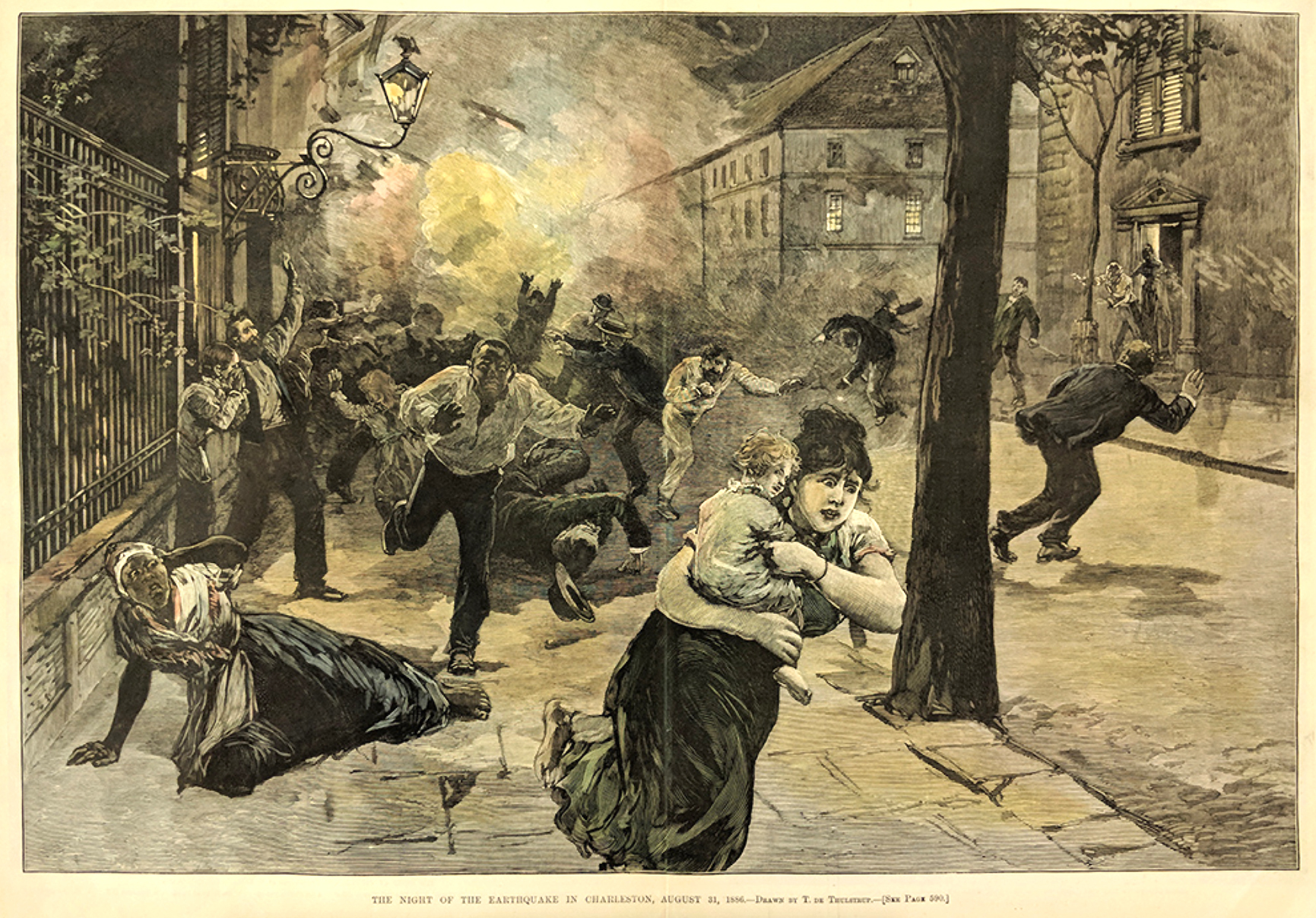
If you've spent any time walking through downtown Charleston, you've probably noticed the decorative iron stars, crosses, and circular plates attached to many of the city's historic brick buildings.
Most people know them as earthquake bolts---but have you ever wondered why they're there? Their story begins on the evening of August 31, 1886.
It Started With a Rumble...
According to reporters at The News and Courier, it started with a low rumble. At first, they assumed someone downstairs was moving something heavy. Then they thought perhaps a wagon was rolling down Broad Street.
Within seconds, the building itself began to shake.
It wasn't a wagon.
Charleston had just been struck by one of the most powerful earthquakes ever recorded in the eastern United States.
One reporter, Carl McKinley, later described the terrifying experience.
The long roll deepened and spread into an awful roar, that seemed to pervade at once the troubled earth and the still air above and around. The tremor was now a rude, rapid quiver, that agitated the whole lofty, strong-walled building as though it were being shaken---shaken by the hand of an immeasurable power, with intent to tear its joints asunder and scatter its stones and bricks abroad, as a tree casts its over-ripened fruit before the breath of the gale.
--- Carl McKinley, "Chapter 1. The earthquake at Charleston" pg. 212, The Charleston earthquake of August 31, 1886 (1889)
The shock waves were felt from New York to Chicago, Bermuda, New Orleans and Cuba. I read that it even caused church bells to ring in Asheville North Carolina. The Great Charleston Earthquake, estimated magnitude 7.3, changed the city forever.
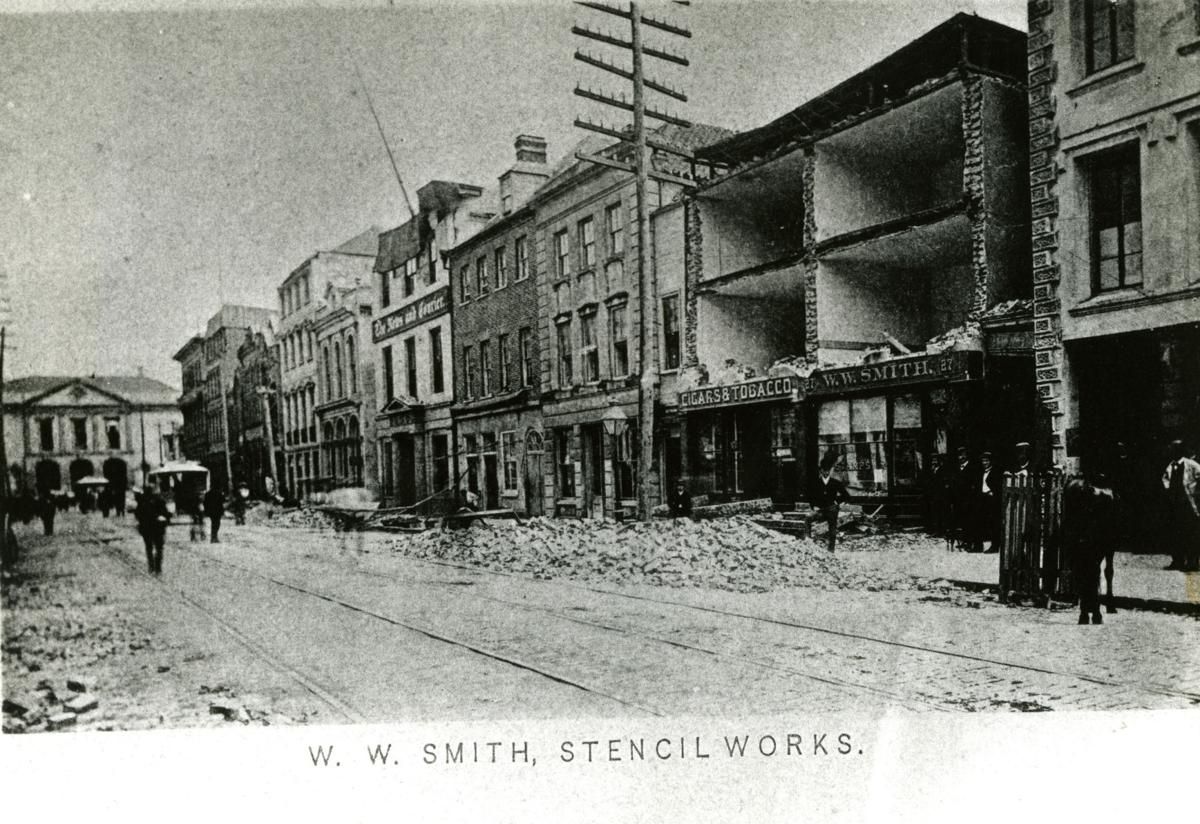
W. W. Smith, Stencilworks, and its neighbor, Cigars & Tobacco, on the south side of Broad Street.
Charleston Shook... Literally.
Nearly every brick building was damaged. Chimneys collapsed, walls cracked, and streets were filled with fallen masonry. At the time of the earthquake there were over 2000 masonry buildings in the city. Of those an estimated 90% suffered damage, and it was widely reported that almost every building in the city was affected in some way.
That first night, fear drove thousands of residents from their homes. Families camped in parks, churchyards, backyards, railroad cars, ships in the harbor, and anywhere they felt safe from falling bricks. More than 300 aftershocks followed over the next three years, serving as constant reminders of the disaster.
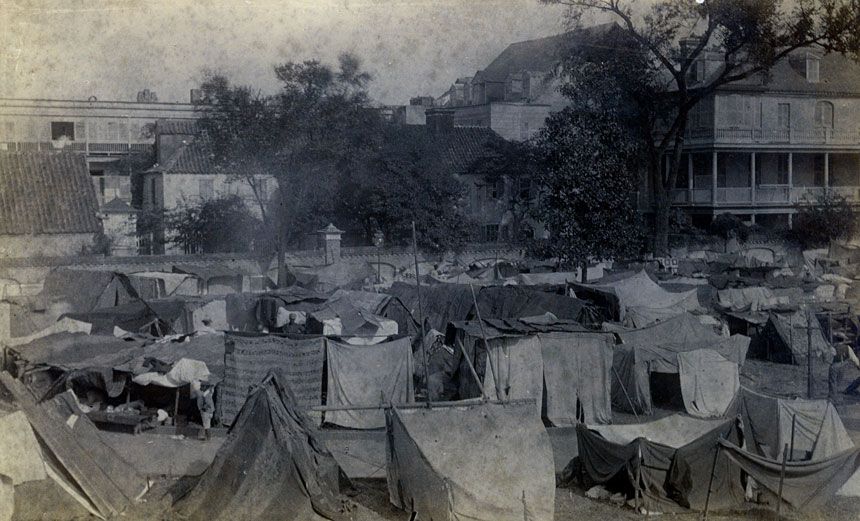
Washington Park on Broad Street
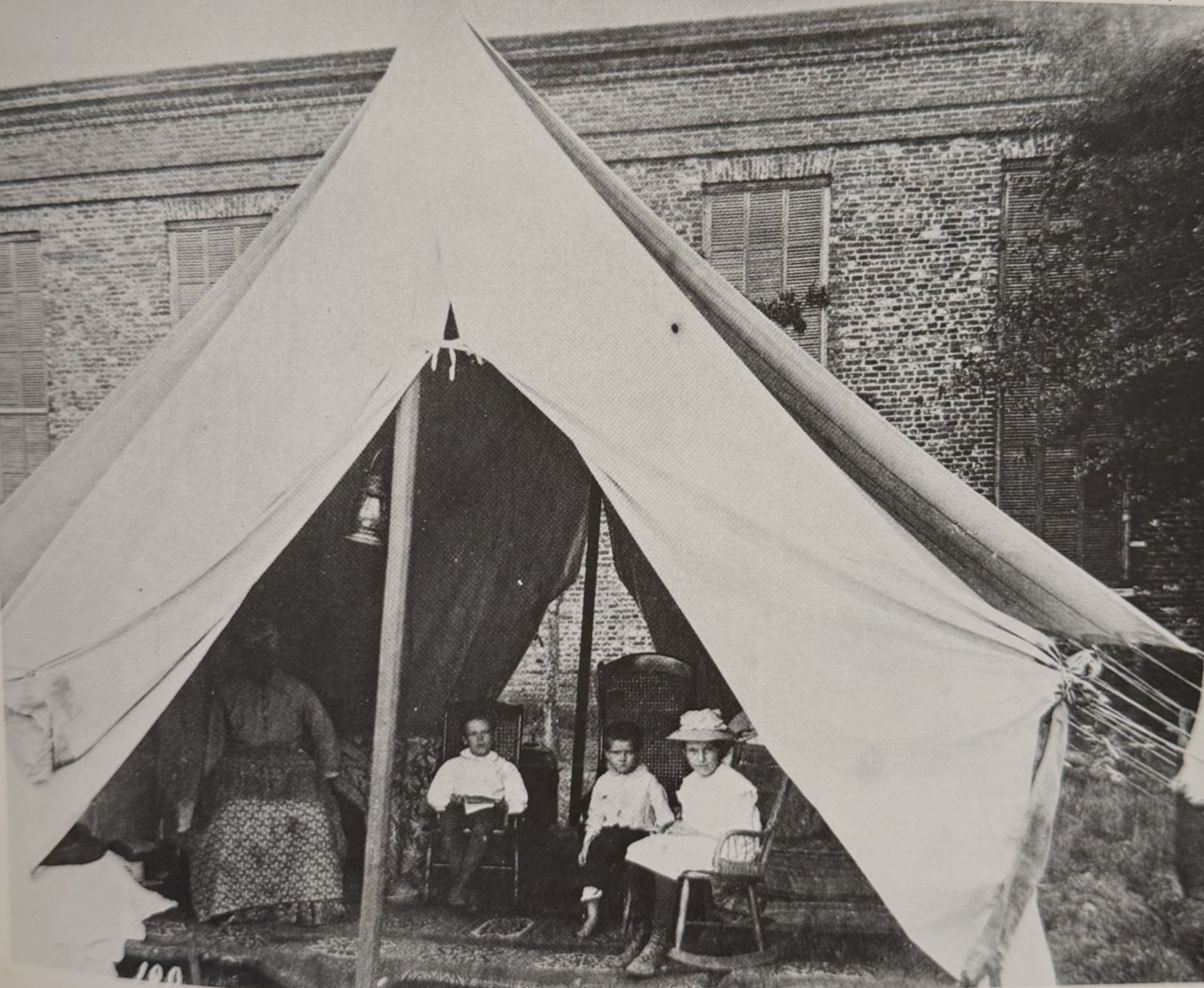
Affluent Charleston Family, Photo from Charleston Library Society. Note the Oriental Rug in the Tent!
Charleston's Resilience
Yet Charleston's story wasn't defined by destruction; it was defined by rebuilding.
Within days, residents, merchants, churches, sailors, and volunteers were clearing debris and reopening businesses. Nearly 10,000 cartloads of rubble were removed in the first week alone. Instead of abandoning the city's beautiful masonry buildings, Charleston looked for ways to save them.
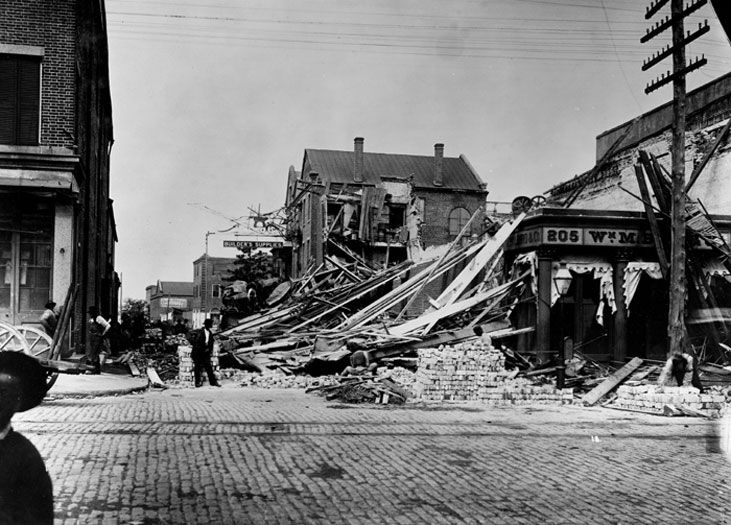
Corner East Bay and Cumberland Street: Office of Wm M Bird Company. The company's building was all but destroyed by the Charleston earthquake of 1886. With roughly 40,000 residents left homeless Mr. Bird anticipated Charleston's immediate need for construction supplies. The business opened for business the next day.
Earthquake Bolts; The Ties That Bind
One week after the earthquake, New York carpenter and machinist Henry Kittridge proposed a solution that would forever change Charleston's skyline. His recommendation to Mayor William Courtenay was both practical and ingenious:
"Most of the damaged houses in your city can again be drawn into shape and made as strong and reliable as ever... by placing heavy angle iron on the corners, and connecting rods with nuts on the end... These strong rods can remain hidden from sight by ornamental heads to cover them."
So... What's With the Stars?
Those reinforcing rods stretched through buildings, tying opposite masonry walls together and preventing them from separating. The decorative iron stars, crosses, circles, and rosettes visible on the outside anchored the rods in place.
Today, we simply call them earthquake bolts.
Interestingly, they weren't invented in Charleston. Iron tie rods had been used throughout Europe for centuries and even appeared on some Charleston buildings before 1886 following the tornado of 1811 and then hurricane of 1885. But after the Great Earthquake, they became a defining feature of Charleston's historic architecture.
Once you start looking at them, you'll see them everywhere.
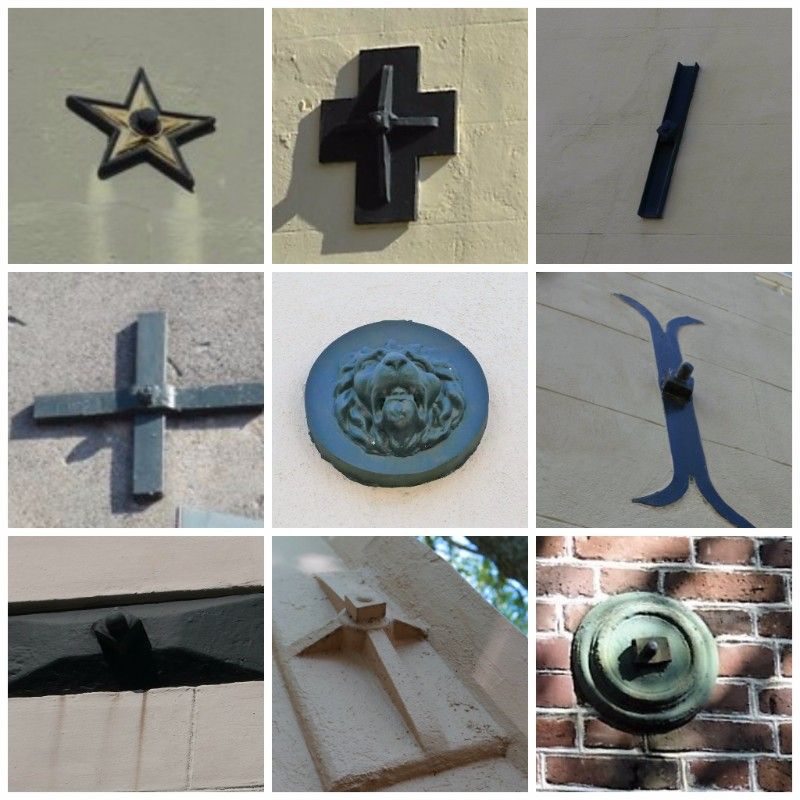
Earthquake bolts appear in many different designs.
More Than Just History
The earthquake also exposed another hidden challenge.
Much of the Charleston peninsula had been created by filling marshes and tidal creeks. During the earthquake, some of these reclaimed areas experienced liquefaction, a phenomenom where saturated soil temporarily behaves like a liquid, making buildings even more vulnerable. Modern seismic studies continue to identify these areas, helping engineers and preservationists better understand Charleston's ongoing earthquake risk.
Today, many of those same historic buildings continue to stand because of the ingenuity of the people who refused to let them fall. The earthquake bolts installed nearly 140 years ago remain an important part of preserving Charleston's architectural heritage, while organizations like the South Carolina Emergency Management Division continue planning for future disasters.
Those little iron stars and crosses aren't just decorative details. They're reminders of one extraordinary night when Charleston shook to its foundations---and of a city that chose to rebuild rather than replace.
Sometimes the most fascinating stories in Charleston aren't found in museums.
They're holding the buildings together.
Want More?

Lois Lane
| Lois Lane Properties
or another way