
Published April 8, 2016
1970s Charleston

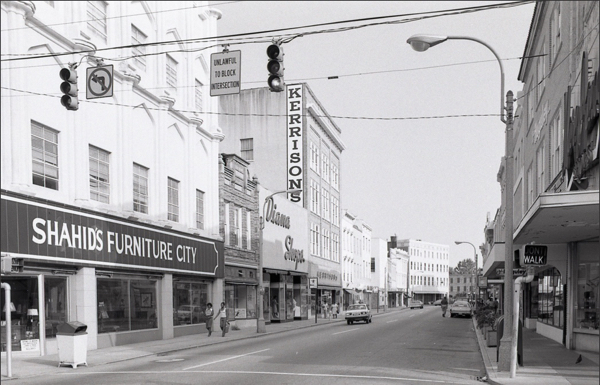
1970s: How Charleston Found its Groove
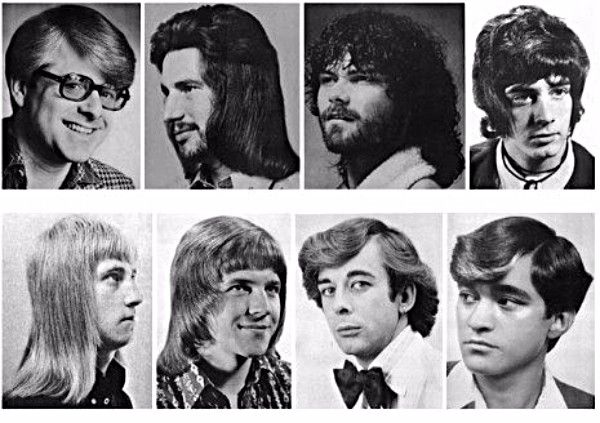
A Collection of Men's Hairstyles from the 1970s. (Neatorama.com)
If you were around in the 1970s, chances are you made some bad choices here and there as you tried to 'do your own thing' or find your groove: disco dancing, leisure suits, and pet rocks...you probably had really bad hair at some point, too. After the turbulence of the 60s, lots of change was in the air as the country--and its cities and citizens--tried to negotiate the best way forward. In the 1960s, Charleston was still a sleepy little town not fully recovered from the effects of the Late Unpleasantness a century before. What the citizen's elite had clamored for since Charleston's Renaissance in the 1920s--a history-driven tourist destination--was still woefully out of reach. The 1970s turned out to be a pivotal time in Charleston's history, essentially setting the direction for the city's revitalization and growth. So, how did Charleston find its groove?
Setting the stage
Mayor J. Palmer Gaillard set the stage for Charleston's growth spurt in the late '60s by making travel to Charleston easier and more appealing with the completion of Interstate 26 and the construction of the Municipal Auditorium which would later bear his name. He was also a key player in securing the site of the original settlement for the creation of Charles Towne Landing in time for our Tricentennial Celebration. Both Charleston's 1970 Tricentennial (celebrated across the state as South Carolina's Tricentennial) and the country's 1976 Bicentennial Celebrations helped put Charleston on the map. Charleston's tourist economy finally started blooming: from 1970 to 1976, the number of visitors to Charleston increased by 60%!
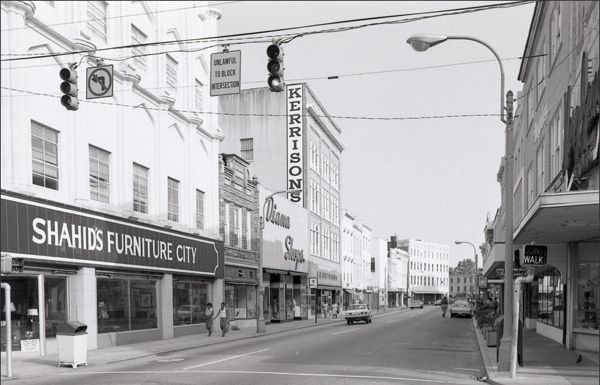
The view south on King Street from Wentworth in the 1970s. The building at the curve in the street is the old Hotel Calhoun, now the site of Charleston Place. Photo Historic Charleston Foundation.
Movin' and shakin'
By the early 1970s, raw sewage was no longer being dumped into the Ashley River, thank goodness, and by 1971, Charleston was the #1 containership port on the east coast. Passenger cruise ship traffic was encouraged and in 1973, a $1,200,000 facility was opened at Union Pier Terminal to accommodate up to 800 passengers per cruise vessel. Development of Seabrook Island began in 1971 and the Kuwait Sheikdom bought Kiawah Island in 1974 to develop an exclusive resort. Mayor Gaillard retired after the longest run as mayor in Charleston's history to date, and Mayor Joseph P. Riley, Jr. was elected to the office at the end of 1975. Now things really started to move and shake around here!
During the 1950s and '60s, many of the peninsula's residents moved to suburbs and began shopping in newly-built shopping malls. Much of downtown was rundown and a lot of business and retail space was abandoned. One of Mayor Riley's early goals was to revitalize the downtown central business district and reverse the trend of retail stores moving off the peninsula. His grand scheme to create a retail/hotel/convention center was one of the most contested ideas in the city's history. After many battles with residents and preservationists, multiple delays and plan changes, his dream was finally realized in the 1980s. In the meantime, he had other things in store for our fair city.
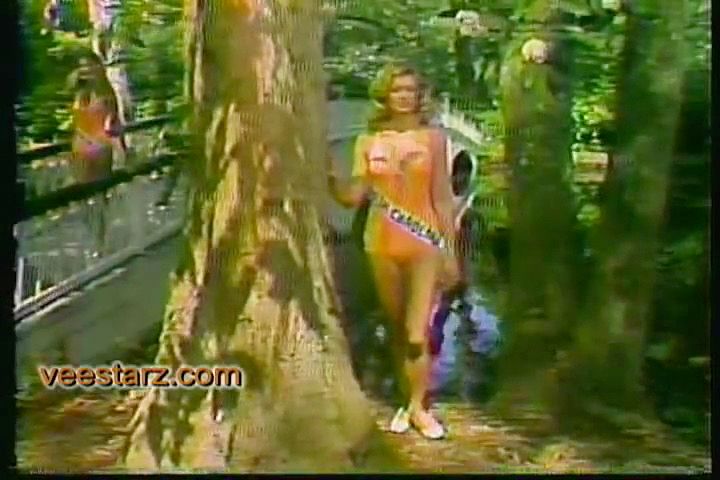
The "Swimsuit Outing" in the 1977 Miss USA Pageant was filmed in Magnolia Garden and Charles Town Landing. Apologies for the poor image quality, but we felt visual proof was required.
It's all happening!
In 1975, the World War II aircraft carrier USS Yorktown was towed into the Charleston harbor to start its new job as the focal point of a museum. Today, the Patriot's Point Naval and Maritime Museum has over 270,000 visitors a year. But two years later, Charleston landed a couple of really big ones: Spoleto Festival USA and, you guessed it--the Miss USA Pageant! It's true: from April 23 - May 7, 1977, Charleston hosted the Miss USA Pageant and then a very dark-haired Dick Clark took the stage with 51 beauties when the show was broadcast live from the Gaillard Auditorium. The Citadel cadets played a large role in the ceremonies, and the pre-taped opening of the program showcased every Charleston charm imaginable. Probably our favorite part of the show is the "Swimsuit Outing" (the pageant always has TWO swimsuit contests), which was filmed at Magnolia Plantation, next to the replica ship Adventure at Charles Towne Landing, and of course, stepping out of a horse-drawn carriage next to booming cannons. (Because nothing exudes beauty and grace like climbing down the steps of a carriage in a bikini and heels!)
Now, the Miss USA Pageant returned the next year, but scheduling conflicts with the Spoleto Festival sent it down to Mississippi after that. Oh, well. Although all of the gazillions of people who watched the pageant on TV got a good dose of Charleston, we're pretty sure that sacrificing the Miss USA Pageant over Spoleto wasn't a bad idea. Plus, 1978 saw the inaugural Cooper River Bridge Run and in case y'all haven't noticed all the people around town this weekend, this now top-five in the country race has turned out to be another event that put Charleston on the map. Those of you that are running tomorrow, good luck!
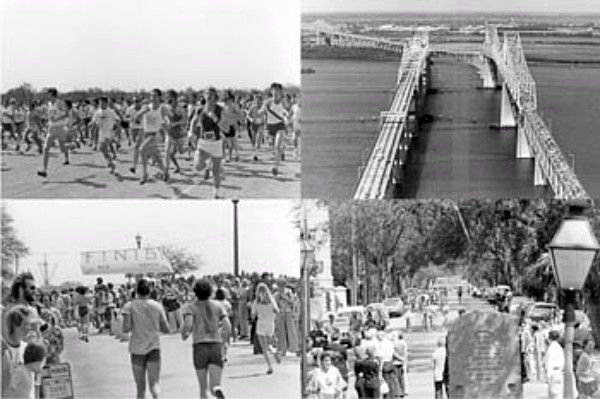
The 1978 Cooper River Bridge Run had 1,000 participants. Image by Terry Hamlin via Mount Pleasant Magazine.
Back to Spoleto
So, now, back to Spoleto, one of the big determinants of Charleston's groove found in the '70s. The first Spoleto Festival opening ceremonies were held in the Cistern Yard at the College of Charleston on May 25, 1977 and the arts festival lasted 12 days. These days, we couldn't imagine springtime without Spoleto and have become somewhat used to all of the national and international accolades Charleston's been getting. But as anyone who was around back then can tell you, Charleston was quite a different scene. Here's what the Washington Post had to say the day after the opening ceremonies:
The opening here yesterday of Spoleto Festival, USA marks the first attempt to transplant a major international arts festival to this country. The resulting glare of the national spotlight, though, appears to have taken this gracious, placid little Southern city quite by surprise, and left it blinking in bewilderment. The sudden jump from quiet provincialism to cosmopolitan celebrity seems, for the moment, more of a jolt than anyone here quite knows how to assimilate...One senses a certain ambivalence among Charlestonians about the event. The News and Courier, the local morning daily, boxed the Spoleto story in red at the top of Page One, and led off by noting that the festival "has critics, politicians, and press across the country sitting up and taking notice." The pride, however, is mixed with a measure of anxiety. Perhaps the first thing on everyone's mind is, can this work? Can a tranquil city of 70,000 with a cultural life of its own sufficiently magnetize festival goers across the city and nation? But the same amount of concern goes into the question of what happens if it does succeed. The glory of Charleston is its untouched surface, the serene elegance of its cobblestones, stately houses and churches, exquisite porches and gardens, all speaking of a past suspended in animation. If the festival brings in the hordes year after year, will it affect the unique quality of Charleston as a place and a way of life?...Around town and on the local TV talk show, attention was focused on an Esquire article about Charleston by critic Albert Goldman who called it "the Sleeping Beauty of American cities" and wonders if something like Spoleto can rouse it from torpor. It's a classic case of a city's 20th-century growing pains, exacerbated by unexpected limelight.
Well, those growing pains certainly helped Charleston find a groove!
Want More?

Lois Lane
| Lois Lane Properties
or another way